🙁think):There may be some confusion here-
Wylk- Apologies if I didn’t explain things that well!
I wasn’t referring to York or any particular manufacturers design- purely the basic principle of that style of boltwork being most commonly adopted on European doors, i.e the rotating disc or plate inside the boltcase that rotates and slides the locking bolts in and out via the visible diagonal slots.
Big round doors weren’t common over here in Europe like Dicey has said- they are a rare minority, but those I know of with the exception of Chatwood’s, seem to work on this basic principle. I likened it to normal free standing safe boltwork as again it is the commonest found on British and European safes with 3 way or 4 way moving bolts- i.e using the diagonal slots to slide the top and bottom locking bolts in and out. This principle is very common here and the rotating disc/plate mechanism just seems a logical adaption of it to operate a big round door.
I am aware that all the different manufacturers all came up with their own drive mechanisms to operate the disc or plate, and their own ideas for locking the boltwork etc, but I am purely looking at the basic idea of the boltwork here without individual makers’ patents and ideas etc.
I called it a ‘drive’ plate purely as it seems the most logical term to me- the big disc or plate in question does of course rotate concentrically about an axis, as opposed to having an eccentric or cranked action as the term ‘cam’ plate would suggest.
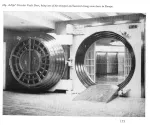
The pics above are all I can find so far- I have seen a Tann and a Chubb also on this principle and will try and fish them out.
The pics are of a Fichet and a Lips door- the Lips door at 40 tons is a fairly big one, the Fichet’s a ‘baby’ in comparison!
The 3rd door is a mystery- I’ve had suggestions as unusual as Chubb, but possibly even a Kaso? I’m familiar with some Kaso high-grade safes, but am unaware if they ever made big strongroom doors like this- Dicey- any ideas? 🙁think):