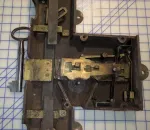
Doug MacQueen wroteIt would help in IDing a lock if the lock cover was taken off. Not disputing what you heard about early safe makers using English locks, as it is certainly feasible, but where did you here this and what were the safe makers? Doug
When I posted this question, my thought was;
someone who specializes in prison locks would be familiar with the lock and would have the information at hand.
I don’t believe it is all that rare.
I didn’t remove the cover because it is riveted on.
Short of undertaking a restoration, I choose not to remove it.
I don’t believe it is foreign made but I acknowledge the possibility that it could be.
As reluctant as I am to get off into the weeds with a discussion of English safe lock manufacturing;
I believe the attached image is one example of an English lock on an American safe. It is from
a 1843 patent S.C. Herring Salamander. If it isn’t Chubb, Chubb should have sued them.
There was a time when the British dominated lock manufacturing and were able to mass-produce
locks at a cheap price.
My knowledge comes from my 50 years in locksmithing and nearly that many years
collecting all things related to locks and safes. In some cases, the knowledge is
there but the pathway to the source material is lost. Short of the presence of maker’s markings,
the information is oftentimes subjective, when it comes to identifying locks.
[unknown]