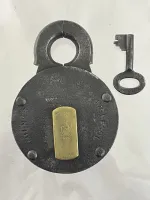
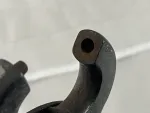
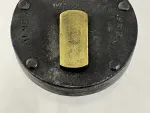
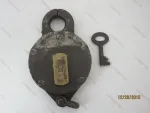
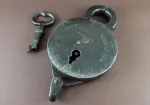
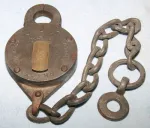
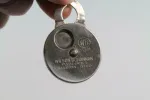
Main body diameter 8.5 cm or 3.3″ Lock overall height 15.5 cm or 6.1 "
The Arthur Linley Padlock History
Towards the end of the Victorian period, a man living in Buenos Ayres in South America applied to the British Patent office for a patent for a novel design padlock. The name of this man was NOT Arthur Linley but George Cooper. Unfortunately the law at that time did not allow people living outside the UK to take out a British patent in their own name, so George Cooper had to work through a patent agent and the name of that agent was Arthur Linley. It is a strange irony that thousands of this pattern padlock were made and sent all over the world, especially to South America, for the Argentine railway the F.C.S (Ferrocarril Sud), all bearing the name of Arthur Linley, and yet his contribution was no more than being the patent agent.
An article in the journal “The Ironmonger” of 1881 describes the launch of this padlock thus:- “The main object in view in designing this lock was to prevent robberies from goods wagons on which padlocks were used. It will be seen that its chief feature is the impossibility of hanging the padlock on to a staple without it being absolutely locked, as when the bow is closed, it cannot be opened without the key. If the bow is not closed the padlock will NOT hang on a staple. Thus by simply observing that the staple has a padlock, the guard may be certain that they are all locked and cannot be opened without the key which he has in his possession. There are obviously other advantages such, for instance, as expedition in locking without a key and with one hand only, which commends this lock to railway companies and others interested in the safe custody of goods”
For demonstration purposes and for exhibitions, a very handsome brass version was made. The “give away” that these brass locks were not intended for actual use, is that they lack the lug (or clevis) always present on the commercial version and these were made of heavy gauge steel and heavily tinned (or galvanised). Once the patent had been granted, Milners were selected to be the manufacturers of the padlock for the duration of the patent (14-15 years). It may now seem odd that a safe making company should be chosen for this purpose. Although in the past (1850-1870) Milners had been dependant on other companies to supply all their locks needed for safes, with the ending of their contract with Hobbs, Hart & Co., they decided to set up their own lock making department. In this they were helped by the fact that the lock making business of Charles St Aubin had just been put into liquidation in Wolverhampton.
This allowed Milners to employ Charles St Aubin as foreman of their new lock making dept. and so recruit all his now redundant former highly skilled lock makers and to transfer them to Liverpool to form the nucleus of Milners new department. Milners were thus well placed to take on the work of making the Arthur Linley padlocks, not being committed to the making of conventional padlocks.
What is interesting is that Milners slightly changed the design of the padlock, so that, instead of having the two halves of the hasp being separately pivoted, they simplified the lock by combining both halves, so that they shared a common central pivot.
There seem to be several versions of the Linley patent lock.
The Linley patent design seems to have inspired a cigar-cutter by Wilson Bohannan. Other trick cigar-cutters are available.
There was an earlier thread which might be of interest, though more is now known.
https://forum.antique-locks.com/showthread.php/5717-1800-s-Crablock-Padlock-Patent?highlight=waine
See also https://forum.antique-locks.com/showthread.php/1719-John-Waine-amp-Sons-Ltd-padlock?highlight=waine