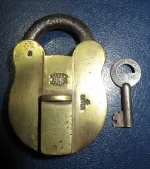
Here is a similar, large Chubb padlock. The serial number is no longer visible and the key is missing, but it is Victorian, and is five and three-quarters inches long, with a barrel and curtain, and detector. Unfortunately, it has been opened at some point, possibly to make a replacement key, and so is of little value, apart from to see what is inside. The ‘artist’ that was let loose on it removed the detector lever, probably to prevent it causing problems in the future. The usual ways to deactivate the detector would include removing the detector spring, bending it out of the way, or removing the pointed part of the detector lever that is caught by the spring. In each case, the lever would remain in place. Removing the detector lever risks allowing the remaining five levers to drift upwards, and out of alignment with their corresponding steps on the replacement key. However, many padlocks of this type, which have been opened to make a key, have had their lever gates opened up to such an extent that the new key looks little more complicated than a blank key. In these cases, lever alignment is probably not so important! The six tines of the lever comb spring, and the bolt stump protruding above the top lever are additional evidence of a missing lever. Compared with the heavy steel shackle, of 13/16″ diameter, the rest of the padlock appears lightweight.
As an aside, here is a picture of a Chubb’s Second Quality padlock. It has four levers, but no detector. It was locked and without a key, when I bought it. Trying the easy options first, I found that one of the Squire range of pipe padlock keys was an almost perfect replacement key.