From time to time I find images of vault doors that are broken, salvaged, vandalized, or gutted. It’s very common to find the time lock has been removed; after all, it’s quite attractive. But a few doors are interesting because of context, or simply how they are broken.

Above, a nice Mosler door with a missing time lock. But it’s in an operating bank, with what appears to be an active safe deposit vault. I wonder, does the bank’s insurance company know the time lock is gone? I remember reading about a bank, the manager stated the door was required to have a functioning time lock, but he was not required to use it (and didn’t).

Above: a Mosler Donsteel door in a former bank. The banking hall is currently an event space. But notice the lower-left portion of the door. Some of the bolts are extended to various degrees, and four of the “crank disks” are missing (that’s what the patent calls them). Why (and how) were the disks removed, and why only four?
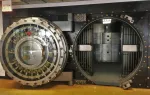
Above: A Diebold door which is missing its time lock (of course), in a vacant former bank. But also notice there are four missing bolts (and pinions), and that they have been removed symmetrically. I am tempted to guess that a vault technician removed them due to malfunctions, and thought doing it in such a pattern would be more acceptable. Or they were removed to repair a similar door elsewhere, in an active bank. This might explain some of the other examples.
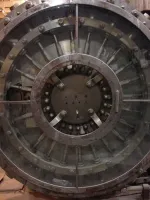
Above, a miserable old Herring-Hall-Marvin door. It’s rusty, missing its time lock, and the glass is broken (and somebody tossed a water bottle inside). But also notice that one bolt is missing in the lower-left corner. Whoever took it out, they at least had the decency to put back the castle nut! The door has since been cleaned up, new glass installed, and even a time lock (that does not look proper).


