I rarely get to visit vault doors in person so a recent trip to Savannah, Georgia, allowed me to look over a door in a former bank at 101 East Bay Street, now used for a variety of offices including Visit Savanna. This is more of a business office for them than a visitor center but they paid no attention to me other than offering to take group pictures with our cameras. I don’t know the history of the building which would help date the door.

Above, a nice image of the door (from https://www.flickr.com/photos/damiavos/4707651586/in/photostream). This image intrigued me because it looks like most Herring-Hall-Marvin (HHM) doors of the “twisty” style (my nickname) but presumably this is a later evolution. Lots of chrome and little (if any) brass. There are no turnbuckles in the middle of the connecting rods. The ball joints are different than older doors. Not too clear in this picture, the builder’s plate does indeed say Herring Hall Marvin. The locks and the boltwork are in the “locked” configuration which is common for doors on display to prevent anybody from trying to close and lock the door. The bolt pattern is offset from horizontal/vertical.

Above, the view when you walk in. This shows the emergency door on the right. It has its own day gate (typical) which was being used to hang a sweater. On the left is a separate vault with a rectangular door.
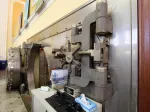
Above, a view of the two doors. Given Savannah’s humidity, corrosion and rust are inevitable.
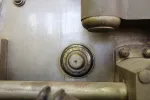
Above, the emergency door’s locks are Sargent & Greenleaf so I assume the main door’s are too (I did not try to move the main door to see). They show a 1906 patent date (May 22, 1906, US patent 821,548).
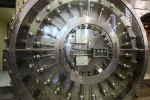
Above, an overall view of the door. Beveled glass, Greek Key patterns, and lots of engine turning. I was surprised at the apparent arbitrary angle of the pattern on the central disc, maybe 20-25 degrees. Did HHM expect the door, when open, to be kept in the unlocked (twisted) configuration? If so, then the locks and time lock would be off-horizontal instead. I’m not even certain right now if that central disc turns or is stationary.
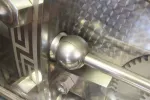
Above, a close-up of a ball joint (which might not even be a ball joint except in how it looks. There seem to be two covers, one front and back, which are likely for appearance only.
This was one of the high points of our visit, at least for me.


