The most visible example I could find is an old image of the Colorado National Bank, a Remington-Sherman door circa 1915:
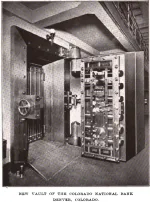
We can see the pin ends on the right and we can see the wheel they operate at the center of the door. It seems fairly clear the wheel is currently rotated counter-clockwise of center and the upper pin is the longer of the two. The “other state” for the door would be to have the wheel rotated clockwise, perhaps to center (i.e. the two bolts connecting the pins to the wheel in vertical alignment) or perhaps beyond, performed by pushing the lower pin into the door (which causes the upper pin to extend outward). Reverting to the shown configuration would mean pushing on the upper pin and allowing the lower pin to extend.
An unanswered question is, was this door photographed with the locking bolts extended or withdrawn? We can’t tell from this image how the wheel is coupled to the boltwork. And I haven’t found any relevant patents.
One way to look at this is the operating pins. It seems to make the most sense that the pins are even with each other (as shown) in the open and unlocked position. After all, they have to clear the door frame. And I don’t see any easy or simple way to extend/withdraw the locking bolts when the door is open.
Looking at the bolts themselves I can’t convince myself one way or the other. The outer ends are extended beyond the support frame but I can’t see what the door frame looks like. Looking at the inner ends of the bolts (e.g. the bottom bolt) it looks like it is nearly flush with the inner support frame, so with any significant extension beyond this the bolt would not seem to be very well supported by the inner frame.
As for One King West we should remember that the door may have been disabled in some way by the hotel for liability reasons, to keep people from playing with it and locking somebody inside. Without closer examination I’d be inclined to trust older imagery a little more than contemporary imagery.
In general, and I think we agree, if the door pins are aligned the door should be “open” and if one pin is extended compared to the other, the door should be “locked.” The same might be true of the pins in the door frame though I could imagine the mechanism might pull the non-pushing driver pin out of the way rather than let the door pin do this, to increase clearance during door motion, but if so I’d expect it to be rather minor.
Finally, as to your original question about extending the bolts on an open door, I suspect this was simply not done under normal circumstances. You might want to do this to make it difficult to lock employees in during a robbery but the pressure-bar system would be entirely adequate to trap folks inside until the bad guys get away. Getting back to One King West (and other no-longer-a-vault doors such as Capital Grille and National Commercial Bank & Trust), things might not quite be normal. And I’m no longer as certain as I was about whether the bolts are extended or not at One King West.
I hope I didn’t babble on too much, I do tend to do that.


