Warren63 wroteHi, i’ve noticed some Milners safes have ‘list’ and a corresponding number on the brass plaques relating to the specifications of that safe in particular. Could anyone tell me if a list 1 would be a highest or lowest quality safe? Thanks .
As was the practice in the latter half of the the 1800’s, safe makers such as Milner, Tann, Chatwood, and later Ratner, used the term LIST to differentiate between the qualities of their products. In each case they started with their lowest specification which was a fire-resisting top-opening chest.
List 1 As from the date of Milner's first fire-resisting patent in 1840 the products were light sheet
iron top-opening chests and boxes
List 2 The most familiar model square wrought iron sheet iron with 1/2" plate iron door, locks
originally by Turner followed by Hobbs who supplied them for the following 20 years before Milner started their own manufacture designed by Aubin.
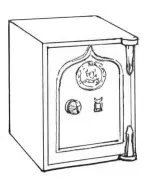
List 3 Sometimes labelled Holdfast, a term used to describe safes with reinforcing iron bands around
the body back and front. These were initially described as being Thief-Resistant until the
event of the Cornhill Robbery in 1865. Strong Holdfast was used to describe the improved
version with much stronger bolt on lockcase and fire-resisting chamber.
 The List 3 Fire-Resisting quality continued up until the 1920’s still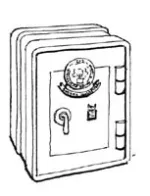
using the external banding now with a 4-corner bent body although the List 2 was by then formed with a 12 corner
bent body with the screw on lockcase replaced with an angle iron framed lockcase with
separate fire chamber.The body plate thickness of the List 3 was only ¼″.
Lists 4,5 & 6. These qualites which started as square banded bodied had increased door and body
thicknesses and with additional drill protection throughout, the doors being up to ¾″ inch
thick. They were fitted with two and three fantail mastered locks.
[unknown]