Glad you liked the pictures Al. The Hobbs was photographed in our yard. It had been installed on a lift platform in Glasgow’s most prestigious jewellers where it was raised from the basement at closing time for loading from the window displays and remained there adjacent to one of the armoured glass shop doors until start of business next day.
The criminals had obtained keys for the door of first entry and the alarm neutralised. The safe was lowered into the basement. At their disposal the had an oxy-acetylene cutter, a packed lance in manageable screw together sections in a golf bag, plus explosives and detonators.
From the attached picture the sequence can be followed. Firsly they attempted to remove a large section from the right hand door. Inexperience meant that they were unable to cut both plates simultaneously which should have been elementary. Next they tried for a smaller section again with no success. The lance was then used and created a hole at the botton right of the small panel.
As can be seen, a very large charge was detonated inside the door using a condom to contain the explosive in position.
If you look closely at the the back of the inner door plate just above the remaining keylock you can just make out a Ratner type dead relocker which had been retrofitted by my company some years before. It has fired and cross-locked but hadn’t a hope in hell!
The Stratford Stronghold in-situ behaved impecably as usual with a basic charge. This was due mainly to the formed steel lockcase designed to give-with-the-blow end remain secure even if the outer barrier pan has been dislodged as can be seen in the attached.
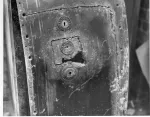
 The very early Duplex (1930’s) was a photograph taken by Ratner in an attempt to discredit the Chatwood against their own Tenacity. There was a weakness in the concealed hinges which the criminals soon learned to exploit before the safe was modified with a rear shooting bolt. This damage, including the splitting of the corners would have been the result of a second bursting charge.


