Hi Adrian- I haven’t a clue as to which manufacturer would have been first with these changes- like everything else I would imagine they were all going down similar routes with similar ideas around the same time. I posted this purely to show this particular generation of the Chubb Treasury doors and their contrast with the more typically cluttered doors that preceded them.
Chubb’s TDR was their legendary barrier material developed to be both Torch and Drill-Resisting- that’s what the abbreviated initials stand for. Chubb always had an obsession with equal all-round protection, and for good reason- a safe is after all, a 5 sided box with the door forming the 6th side. Paying more attention to any one of the 6 sides means weakness. Lots of manufacturers would often build loads of defensive barriers into the door of a safe, but not in the safe’s body, creating obvious weaknesses.
With booms in metal cutting techniques and attack technologies Chubb’s idea was to produce a safe with equal high-level defences on all 6 sides-
The body of the safe being made as a hollow shell of heavy steel, folded and continuously welded. The TDR alloy was then poured molten into the hollow shell to form a solid, 5 sided ‘bell’ casting without any joints. The door followed the same construction with a single cast slab. It was an aluminium alloy with extremely hard nuggets randomly dispersed throughout the metal. Aluminium has a reasonably high level of heat conductivity, so the thick joint-less block provided good torch resistance without the excessive cost of using copper. The incredibly hard nuggets dispersed through the alloy gave superb protection against drilling. They did however use copper for one of their top-of-the-range freestanding safes- the ‘Sovereign’, but that’s another story. I can remember the final model before withdrawal being priced at over £15,000 + VAT in the mid 1980’s- a seriously expensive safe.
Interesting that some American websites I’ve seen still list the Chubb Sovereign as the highest grade free standing safe ever made- often a battle with Tann’s Diamond and the SLS Gem, but only 2 of the SLS were ever made. This Chubb Sovereign is not to be confused with later models of the same name though- why manufacturers confuse by doing this escapes me.
Anyway back on subject, Chubb’s TDR was a revolution in safe making, and the 2 foot thick slab cast into these 33 inch Treasury doors combined this modern barrier development with modern appearance.
Getting back to the original theme- the change to ‘modern’ uncluttered doors, I’ve got a few more examples which illustrate the transformation.
The 1938 Treasury door that wylk posted is a good example- typical of the day with massive crane hinges, huge pressure bars and capstan (or ships wheel) style handles. These typical heavy doors were made by all the manufacturers for a long time with little in the way of change, and if it wasn’t for the Chubb badge on that one it would probably have a lot of people guessing.
Chubb’s Treasury door launched at the 1951 festival of Britain was the start- this is the one which received high acclaim for both performance and appearance.
Picture from David Ibbs’ superb site: http://www.historywebsite.co.uk/Museum/Engineering/Chubb2/Recollections.htm
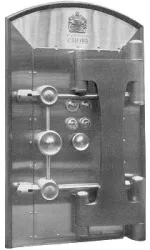
Still has heavy pressure bars and crane hinges, but shows the start of the clean and smooth appearance with rounded edges on brackets and contoured handles.
This was 1951- at the same time Chubb also made doors for the Bank Melli and Bank Markazi of Iran, the main one of which was for the Persian Crown Jewels and the Peacock Throne. This door, completed in the same year is interesting in that it’s of 1930’s appearance- back to multiple steps on the door, heavy pressure bars and capstan style handles.
Here’s a scan of the Bank Melli door from the Chubb Collectanea book:
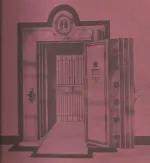
This door’s appearance could pass for being made 50 or 60 years earlier, and yet it was completed the same year as the door shown above at the Festival of Britain.
Only a decade or so passed before the Treasury door launched at the Festival of Britain lost it’s smooth round handles, crane hinges and pressure bars for the uncluttered doors shown at the start.
So there you have it- between the Bank Melli door above, the Festival of Britain Treasury and the 1960s Treasury ⅔ doors there’s little over a decade separating them, and yet in terms of appearance they could span more like a century.


