Hello Safeone, I’m sorry to say that Gunnebo are at the root of the problem in acquiring technical detail.
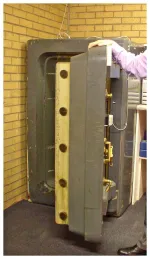
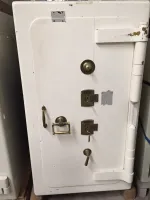
When I first acquired a couple of the CB’s from the Royal Bank of Scotland’s surplus stock (bank closures) I was able to speak with my counterpart in Chubbs who gave me the briefest of detail such as the date of manufacture and the fact that a small number of these Specials had been made to the specific request of the old Commercial Bank of Scotland, later to become the National Commercial and finally the Royal Bank.
I didn’t pursue the matter in detail as at that time I had little interest in the history of safes.
Although this was around the late 1970’s I had remembered that we had sold one to a Glasgow Cash & Carry Company and then, 40 odd years later when I began to expand my website, I decided to attempt to trace the only specimen I could remember. Despite much resistance from the security manager I managed to briefly grab a photo or two.
Despit many subsequent emails and telephone calls Gunnebo have proved to be decidedly obstructive despite admitting that the information is held on Fiche.
Earlier this year I got a call from a Glasgow company of safe removal specialists who had been asked by the Royal Bank to remove one such CB from a branch office but the fact that part of the bulding had been build around the safe made this impracticable. If I ever learn that this branch is to be demolished I’ll let you know.
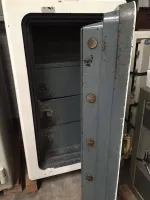
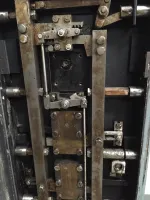
Subsequently I’ve come across what I initially mistook to be the same quality only to realise that it was a Special Diamond which would have been produced around the same time as the CB. The door is stepped at 2″ rather than 5″ and the carriages are of the standard quality whereas the CB carriages are more of the strongroom door design. Another difference is that on the CB, a thick steel plate frame of ½″ or more was
welded to the body around the front on the door aperture to strengthen the mounting of the carriages to which, incidentally, oilers were originally attached.