Doug it was exactly the same for me after cutting keys it was the first ‘proper’ skill I learned, and have to say it’s been one of the most valuable in so many applications. As a teenager I got into repairing and then building live steam locomotives so my experience grew no end doing repairs, making my own parts and eventually boiler making.
I’m still using solder from stocks I bought twenty odd years ago, and still using the same torch set up which is probably as old as me. The burner nozzle that’s fitted is the all rounder, the small one on the firebrick gives a precision pin point flame, and the bigger one that’s stood ups the roarer for the bigger stuff:
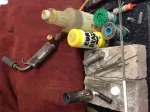
The solders pictured cover a massive range from a Woods metal derivative with only 90 centigrade melt, through the soft ranges to the hard silver solders upto C4 brazing alloy which I think is around 800 centigrade, used for multi- stage joints.
Hard solders are on the left on the firebricks, soft solders on the right. The blue roll is a real oddball- long obsolete LM15- a mid range high melt ‘soft’ in between the soft and hard ranges, was a ridiculous price from Johnson Mathey, back in the late 80’s but worth it’s weight when needed.
The most versatile of the hard silver solders for lock and key work for me, without any doubt has been JM Easy-Flo, the all round King and also Easy-Flo2, although I’m since told they have all been changed now in line with European regs.
The C4 alloy with the highest temp I only ever use for brazing fire tubes into the throat plates in coal fired boilers, the amount of heat needed is pretty fierce tbh, and way unnecessary for general lock and key work- does have a lovely distinctive brassy gold tint to it though as opposed to the pale silvery flash of the others.
Like Doug has already said its horses for courses, they all have their place and it’s a case of working out what’s best for what you’re doing and then practise. Doug Your summary you posted earlier in the thread, I thought was brilliant as you mentioned the importance of joint tolerance with the harder solders, something not critical with most soft solders but an aspect difficult for beginners as it calls for accurate filing and precise joints.
Also worth noting for beginners, be patient bringing the work up to temperature, let the work melt the solder when ready and not the flame, it’s critical with the harder silver solders as it’s tempting to try dabbing the solder way too early and the resulting melted blobs will actually take an even higher temperature to re-melt, by which time the flux will have dissipated and it’s all gone horribly wrong…
Another final note for beginners, it’s worth remembering you can’t ‘push’ the solder into joints, it’s drawn in by a capillary action and ‘flashes’ through when everything is just right, again it all comes with practice and needless to say experiment on mock set-ups rather than your most prized antique key!


