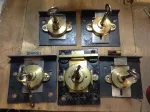
Having found some more Climax Detector safe locks in storage, I’ve spent some time working my way through cleaning and making keys for them.
All were in extremely poor condition and sadly without any keys. They were also way beyond a light clean to preserve any patination. I always prefer to retain a locks original paint and patina, but the corrosion on these was serious and had no real choice but the clean and paint route.
Heres 2 completed with the closest example still in ‘before’ condition for comparison:
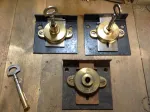
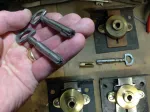
Key blanks were carefully sized to the barrel by hand, and the end bore drilled to suit the drill-pin in the lock cylinder:
These antique blanks already had a pretty accurate 1/16″ pilot, so all they needed was careful drilling out and reaming by hand.
Keys were then carefully (more like tediously- especially on the deep cuts) cut, using a sharp ‘knife’ profiled needle file to match the contour and depth of each slider.
Working around the barrel cutting the slots to each slider in turn:
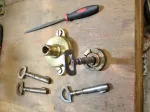
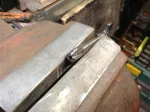
Nothing fancy needed here- key blank simply held in the bench vice to cut the radial slots:
These locks always seem to hold a few hidden surprises, or perhaps that should be a few hidden ‘shocks’…
Worn-out Cylinders, packed with 150 years of muck and grime that actually look reasonably intact, with all the sliders in place…
“Great!! This ones going to be a good ’un!”
A complete strip down then reveals 4 or 5 of the springs are broken, often in 3 places each, and several cracked sliders actually being held in place firmly by the solidified muck. Not good…
Thankfully while doing these few there were also a few good surprises as well :-)
Working on an 8-slider lock and cleaning the steel bolt with emery cloth, I could make out what looked like writing in an arc on the reverse side of the bolt. A lot of very careful cleaning with jewellers fibre sticks eventually revealed the name:
J WOLVERSON
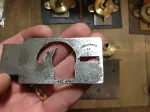
All I could find was from the late Jim Evans’ Gazeteer of Lock and Key Makers which briefly lists Joseph Wolverson Union St, Willenhall as advertising in 1851 as manufacturers of patent rim and mortise locks.
There is also mention elsewhere of a patent date of 13th June 1840, and also his involvement with William Rawlett, but nothing as to what patent, or for which lock etc.
Apart from the 8-sliders (most are typically 7) and the slightly off-set cylinder nozzle there is little distinguishable difference between this example and any of the other types, cylinder, springs, sliders etc all pretty much the same.
In addition to this Wolverson example I also have a very grim condition Wilson- that’s pre Cotterill-Wilson days with the bolt marked only Wilson. I’ve seen another Wilson before and both examples have all brass cylinders (no steel ring on the back) and also all brass bolts, making them slightly visibly different to the others.
This Wolverson has been a great surprise find though, and any info however seemingly small would be appreciated.
over the years I’ve owned and handled dozens of these locks but these and a few rusty scrappers are all I have now: