Thought I’d share this as it’s another unusual one.
A skilled joiner who specializes in preservation work contacted me regarding some unusual window catches he was struggling to find.
Fitted on a protected Estate now over 100 years old, he explained they were unusual in that they resembled the type of catch normally found on sliding sash windows, but unusually were fitted to hinged casements.
Upon examination, I could see they were an unusual variation of the traditional British Brighton fastener, with some interesting and unusual differences.
The tricky bit for me was they wanted a batch of multiple exact replicas, and every single component part had to be inter-changeable with the original fittings. Even the domed end-caps on the studs were threaded and removeable- not something I’d seen on this type of fitting before.
Heres an original fitting with my #1 test piece.
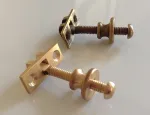
Observant viewers will notice the housing that the stud pivots from is actually reversed to normal. These are actually let flush into the wood and not fixed proud on the surface as on the sash type.

Making the pivot housings was by far the most time consuming part- with so much metal removed for the cut-out for the pivoting studs and the large countersunk screws, milling each from solid bar of exactly the right width was the only option. They insisted that every aspect of the replicas be an exact match for the originals, so I also had a bit of fun with the inter-changeability of the old and new knurled nuts, but found a way around it and got there in the end. Thankfully they were all an old British imperial thread for which I already had the cutting taps and dies.
Surprisingly they wanted the initial batch bright finished as made, but I couldn’t resist seeing how close I could get a newly made replica to match their tarnished originals. A week of treatment using my own basic recipe and I think it turned out quite convincing.

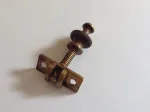
I’ve since restored a box full of worn and broken examples they’d found in storage, and in doing found there’s even more variations on them than first thought.
All this was really enjoyable and extremely rewarding personally to be part of a large conservation project-
Equally rewarding was finding out that after all these years, I was actually the only person they’d found who was willing to make exact reproductions, and had the confidence to guarantee their compatibility with their worn original fittings.
