Hello Krikretep,
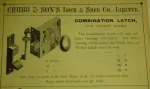
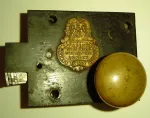
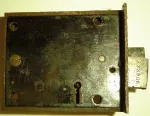
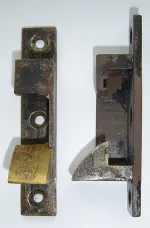
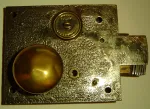
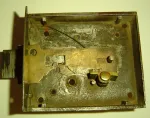
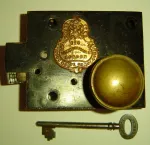
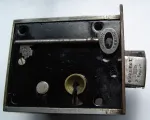
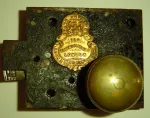
This lock was used for inward opening doors, and fitted inside the room. For a person inside the room, the lock was slammed closed, and the levers rose up the brass slope of the receiver. The lock was opened with the handle which, through a follower inside the lock, set all the levers to the correct heights for opening. When outside the room, the lock was also slammed closed, but opened with the rim-length key. The receiver and levers have a type of false notching.
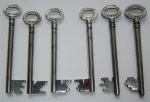
The earlier locks with the St. Paul’s address usually used pipe keys, which offered a little more security. Later locks with the Queen Victoria Street address used pin keys, presumably because it was cheaper to make the keys and not have to fit a drill pin into the lock.
The Chubb lock with serial number 373506 dates to January 1861.
A similar lock, marked ‘Secure Lever, Combination’ but not made by Chubb, has 6 levers, and an extra, brass, conventional type lever. I think that this is an extra defence against the practice of trying to open the lock by pushing a knife between the door and its frame, to lift the other levers and open the lock. The knife would hit the brass lever, an so would be unable to sufficiently move the other levers upwards.