As a result of a request from another visitor to the site and also from the purchaser of the lock, I dug around and found some pictures of the safe which held the mechanism and am posting them here as a coda to our discussions and a thank-you to everyone for their help. I am including my comments to the lock purchaser to help put the photos in perspective.
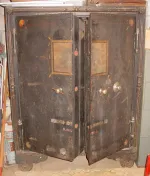
The first photo is a view of the front of the safe with the doors closed. At the time these pictures were taken, we had not calculated the combinations and it was absolutely forbidden to close the doors all the way lest we not get back in! You can read the safe manufacturer’s info on the face: Herring Hall Marvin Co. of Hamilton, Ohio (with no Oklahoma or Oregon yet, they didn’t need the ‘h’ on the state abbreviation).

The next photo shows the safe with all doors open. Those exterior doors were concrete filled and if you managed to get them open, all you saw was the second set of doors. Very disappointing to some safe cracker of the day. Behind those was the large open section at the bottom and the two timelock protected vaults at the top. The mechanism is visible on the right hand vault. This door overlapped the left hand vault and thus both were protected by the timelock. The name of the bank is visible across the top of the safe: The Gilmer County Bank. The bank was likely located in Glenville, West Virginia as that is the only town of any size in the county. If you do a Google on “Gilmer County Bank” you’ll find one in Georgia, but that isn’t the one.
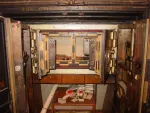
The next photo shows a closer view of the top two vaults. Visible in the right vault is the component that attached to the drawbar mechanism (see next photo for location) and interacted with the timelock (through the visible hole) to control timed safe access. Visible in the left vault is the plate array that actually was spun by the exterior dial to allow access to the vault. In retrospect, I wish I had taken these as well as all were beautiful pieces of craftsmanship. The one for the left vault was particularly interesting. Instead of fixed pins to control the interaction of the rotating plates, one side of each plate had a hinge point with a small “floating” widget that moved back and forth between two padded pins. When the dial was turned and the faint click would be heard through a stethoscope (yes, it does work) the click would be the sound of the pin striking the small swing-arm widget. Then the swing arm would move about 3/16″ before it struck the padded pin and really started to turn the next plate in the stack. Devious, and effective. The padded pins could be repositioned to change the distance before contact so even a thief who knew the concept couldn’t predict exactly how far off the ‘click’ was from real motion.
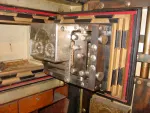
And finally, the last photo shows the lock in working position. To the right of the lock is a tall rectangular plate with a large bolt at each corner securing it to the horizontal drawbars and two bolts (seen partially backed out) diagonally opposed to one another near the center of the plate. These two bolts secured a plate with attached arm (seen inside the vault at the far left of the photo) that was aligned with the hole in the timelock itself. When the timelock was ‘closed’ the hole was blocked and the bars could not be withdrawn. The red areas around the door are a felt material that sealed the vault pretty well from dust and debris. I guess if the outside got blown they didn’t want the money getting dirty!
The pictures aren’t the best. They were taken in 2003 with a fairly low resolution camera (at least by today’s standards). The safe still lives in the basement of my grandfather’s (former) home in Burnsville, West Virginia where it will likely be as long as the house is standing. The walls are double eight-inch concrete block with filled cores, and the floor and ceiling are eight-inch double pours (four inches each) of reinforced concrete. The safe is bigger than the doorway, so it’s not going anywhere without a lot of effort. While I don’t doubt that the family would sell, the cost of removing it from the basement (and repairing the damage!) would likely be far more than any rational person would pay. It certainly kept me from giving it more than a passing thought.
Once again, my thanks to all here (particularly OldLock) for all your help. I hope these views of the mechanism “in situ” are of interest.
— Ed


