A brief history of the Chubb Detector lock.

Introduction
Many locksmiths, safe engineers and collectors have seen and are familiar with the operation of the Chubb Detector lock. However what is less well known is that there have been five ¹ different patented versions of the detector, each version being designed in response to a particular problem / threat.
From the point of view of the locksmith & safe engineer it is comforting to know that the Detector lock was not used as the primary lock on cash safes after around 1860 or so, although they were used on internal fittings & strongboxes etc for much longer and on government cabinets into the 1950’s ²
1st Patent – February 3rd 1818
In 1817 a daring robbery was carried out with common lock picking tools and it lead the government of the day to issue a reward of 100 pounds to any lock maker that could produce a lock that could not be opened by anything other than it’s true key.
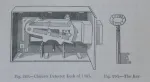
Chubbs’ design met the criteria and won the reward. The earliest locks are extremely rare, I know of only 1 example which was in the possession of Chubbs but it’s current whereabouts are unknown ³. It was photographed for an article in Keyways in the early 1980’s and is shown below [ Image 1 ] with the stated date of April 1820. There are a couple of design features that may identify such an early lock.
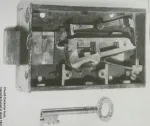
A : The second, or detector reset stump is outside the lever.
B : The design required the regulating (reset) key to be a different pattern to the actual key as to reset the detector in this early design the key had to be turned as if to open the lock, rather than to lock as in all later versions.
Note the use of a different regulating key can be found in later locks – usually for locks used in prisons to alert the governor or senior officer to any attempt to tamper with the lock as only the governors key would reset the detector.
The 1st patent lock had the see-saw or rocker arm type detector and only four variable belly levers.
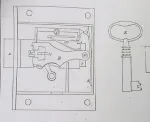
It should be noted however that even this early lock is not the same design as the original 1818 patent documents show. [ Image 2 ]
2nd Patent – June 15th 1824
Chubbs’ Improved Patent – AKA ‘ See-Saw locks ‘
The use of a separate regulating key was found to be inconvenient and the design was modified in 1824 and a new patent issued. In order to accommodate the change it was necessary to redesign the lever to incorporate a second set of gatings to allow the same key to be used to reset the detector.
Such locks are scarce, the example shown below [ Image 3 ] is from my own collection and is the third oldest Chubb lock known to me, being made in April 1827.
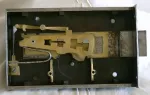
In common with the 1st patent, this design of lock only had four variable belly levers.
Some collectors are unaware that there was a picking challenge prior to the events of the great lock controversy of 1851. In May of 1832 Chubbs’ issued a challenge which Thomas Hart accepted, having claimed that he could pick them easily and that he had picked some 18 locks, many in the presence of witnesses.
But at the time of the challenge Hart failed – because the lock he was given to pick had a complex bridge ward in addition to the detector. Having read the accounts of the event & the description of the equipment he arrived with it is clear that Hart had previously opened Improved Patent locks by impressioning as the lever belies were far from uniform.
3rd Patent – 20th December 1833
Chubbs’ New Patent – AKA ‘ Kidney Lever locks ‘
In 1833 the ‘ New Patent ‘ lock was patented, this design was intended to have three main advantages.
A – The detector was much simpler in design and therefore easier & cheaper to make. The same may be said of the lever spring which only required a simple curve rather than a sharp bend.
B – The amount of effort required to trip the detector was to be greatly reduced, for anyone attempting to pick an earlier lock a far higher amount of lifting force would need to be applied to any lever to move the see-saw detector past it’s spring. The new patent design takes far less effort and is as a consequence a person attempting to pick the lock cannot rely on the additional weight of the detector as a help in picking the lock *.
C – To allow for the use of dual control or double locking mechanisms without great additional expense in manufacture.
The lock shown below [ Image 4 ] is a typical iron door (safe) lock of circa 1837. This example only has four levers in common with earlier locks, however Chubbs did produce 5 & 6 lever versions.
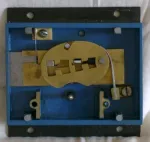
It was this design of lock that was to be the first of the Chubb locks to fall before A. C. Hobbs. He picked open a six lever new patent lock that was in used on a strong room door in Westminster in 25 minutes., the lock in question being approx. 5 years old at the time.
4th Patent – Circa 1846 / 1847 – I have no copy of this patent.
This lock is almost the definitive or final form. The lever design is changed to make the bellies uniform and the detector position is changed.
The picture below [ Image 5 ] is taken from Geo. Price. and shows the detector lock as it was being sold in 1851. I am sure that even if Hobbs had been faced with this version rather than the ‘ New Patent ‘ it would have posed him no problems.
5th Patent – 1st November 1852
The design of the detector lock now reaches it’s definitive form, although slight modifications are made after this time, there are no further significant changes made. The improvements are :
A – Extensive false notching is introduced, both on the unlocking and locking face of the gating & bolt stump – Note : The notching is usually not present on locks made a few years later as per the example shown below [ image 6 ] .
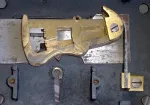
B – The barrel & curtain is introduced to block off access into the keyhole and restrict the movement of tools within the keyhole once the curtain is turned.
I hope you find this of interest. I cannot guarantee it is all 100 % accurate as information can be a little thin on the ground in some cases. I would welcome any additions / corrections.
Paul
Notes :
¹ I have only covered the five main examples in this article. Chubbs made constant changes to the designs and there are locks which are variations of one example or another. Also Chubbs modified earlier locks; for example adding curtains to new patent locks so they could be sold.
² Detector mortice locks were produced into the late 60’s. I heard it said that Chubbs did produce Detector locks to special order for government clients etc after this period.
³ If anyone knows exactly where this lock is I would be interested to know !!
- It has been remarked that the presence of the detector may actually be an aid to picking, that a skilled lock picker will note the extra torque he is applying to lift a particular lever when it starts to move the detector lever and as such know that he is only slightly above the gate in the lever he is manipulating.

